Opening hours
Mon-Sun: 09:00 - 17:00
It is a true treasure chest of history, art and religiosity, giving a sense of the mystery enclosed within the ancient walls of this Angevin foundation (1279) in the heart of the historic centre of Naples. Indeed, in its centuries-old history, it has undergone many transformations, as amply documented by the traces of artistic stratifications, making it a place of particular interest for the possibility of allowing different styles and sensibilities to coexist - as often happens in ancient monumental foundations - according to the historical needs and aesthetic taste that inspired them.

One of the most exciting and discussed traces of this interweaving of history and mystery emerges in the research currently underway since mid-2014, where questions about the identity and location of the fifteenth-century noble tomb of the Ferillo family in the minor cloister of S. Giacomo della Marca seem to lead towards the legendary character of Prince Vlad III, to whom the literary figure of Count Dracula refers. The presence of rich esoteric and alchemic symbolism - such as the presence of inscriptions on the walls with cipher codes that are not yet understandable - make these places legendary.

In addition to the many works of great historical and artistic value, which celebrate the monumentality of the place - e.g. the beauty of the golden ceiling of the Church - there are already 93 contemporary artists, whose 148 works from 1949 to the present day are almost a humble extension of the great patronage of art that was the progenitors of this insula of life and art.

This interweaving of the Christian Gospel and the mysteriousness of the dramatic clash between good and evil is also aided by the recent itinerary dedicated to nativity scene art, which not only expresses craftsmanship but, above all, the ability to reinvent in the wake of local tradition.
The Church of Santa Maria la Nova is called la Nova to distinguish it from the Church of Santa Maria ad Palatium, dating back to the Swabian period, which stood on the site where the Maschio Angioino was later built and where a convent of Friars Minor believed to have been founded by St Francis existed since 1216.
Charles I of Anjou, wishing to build Castel Nuovo, demolished the complex, giving the friars in exchange, on 10 May 1279, the site where the present church stands and on which stood, guarding the port, the ancient Torre Maestra. The convent was built on top of the ancient structure, and a reminder of the primitive arrangement is the almost wall-like appearance that the complex takes on via del Cerriglio, with the bell tower erected where the tower probably stood, and with a façade punctuated by a bull-shaped frieze, open only by a few tall windows and adorned by a simple statue of St. Anthony of Padua. Santa Maria la Nova was built in Gothic style, but the architect of its construction is unknown.
The building in its original appearance was little more than three centuries old. Among the causes that led to the demolition of the Angevin church were the earthquake of 1456 and those of 1538, 1561, 1569 and 1588, but, to a greater extent, the outbreak of the powder magazine of Castel S. Elmo, struck by lightning on 13 December 1587, which seriously damaged it. The rebuilding of the church in 1596, attributable in part to Agnolo Franco, was also due to the generous offerings of the faithful followed by a miraculous healing of a poor cripple from birth, attributed to Our Lady of Grace on 17 August 1596.
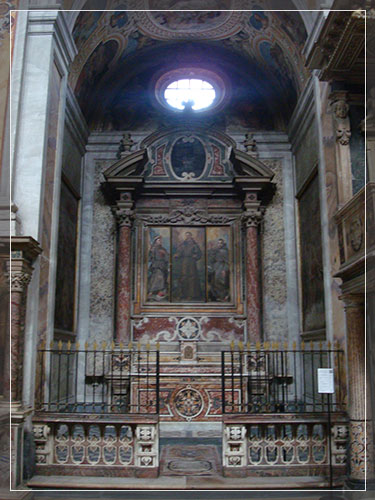
The Monumental Complex includes two cloisters, the smaller one of which, housing some sepulchral monuments from the church, is frescoed with episodes from the life of St. James of the Marches, traditionally attributed to Simone Papa. The side of the smaller cloister leads to the richly decorated Sacristy and the Ancient Refectory, adorned with a fresco by Bramantino: The Ascent to Calvary.
The current façade of the church, with two orders, the lower of which is in exposed piperno stone, is typical of the type common in Naples in the 16th century. It is preceded by a flight of steps with a marble balustrade; at the top, the portal, flanked by two granite columns, is surmounted by an aedicule depicting the Virgin, by an unknown sculptor from the first half of the 17th century.
Wooden and carved chest of drawers, decorated in pure gold, with Stories from the Life of the Virgin, Saints, Prophets, Virtues and Figures from the Old Testamentexecuted in the early 17th century by Belisario Corenzio, Luigi Rodriguez, Cesare Smet and Giovan Bernardino Azzolino.
In the central boxes:
- Francis CURIA (c. 1538-1610), Glory of the name of Mary.
- Girolamo IMPARATO (news 1571-1607), Assumption of the Virgin (1603).
- Fabrizio SANTAFEDE (news 1576-1621), Coronation of the Virgin (1601).
Between the windows of the nave and on the counter façade:
- Belisario CORENZIO (1558 - after 1646), Articles of the Creed (1605), Our Lady of Grace and Punishment of the Damned.
Lunettes on the arches of the chapels:
- Nicholas MALINCONICO (1673-1721), Virtues (1699-1701).
Top of the transept:
- Nicholas MALINCONICO (1673-1721), Adoration of the Shepherds (signed and dated 1703) and Adoration of the Magi.
Based on a design by Cosimo FANZAGO (1633), Agostino BORGHETTI (active in the first half of the 18th century), statues of St. Anthony and St. Francis.
On the altar:
- Unknown master, Madonna and Childpainting on copper from the ancient church.
On either side of the altar:
- Raphaël MYTENS, Two putti holding a torch
- Unknown Neapolitan master, tomb monument of the d'Afflitto family (1580).
In the vault and on the choir walls:
- Belisarius CORENZIUS, frescoes with Stories of the Virgin and Prophets (1603-1621).
The cloister has frescoed vaults with episodes from the life of St. James of the Marches, traditionally attributed to Simone Papa, and numerous 15th- and 16th-century funerary monuments arranged along the walls coming from the church.


STAY IN TOUCH
Mon-Sun: 09:00 - 17:00
Copyright 2023 © San Martino Alberghi Srl All Rights Reserved
Privacy Policy / Cookie Policy
Developed By Business Boost